

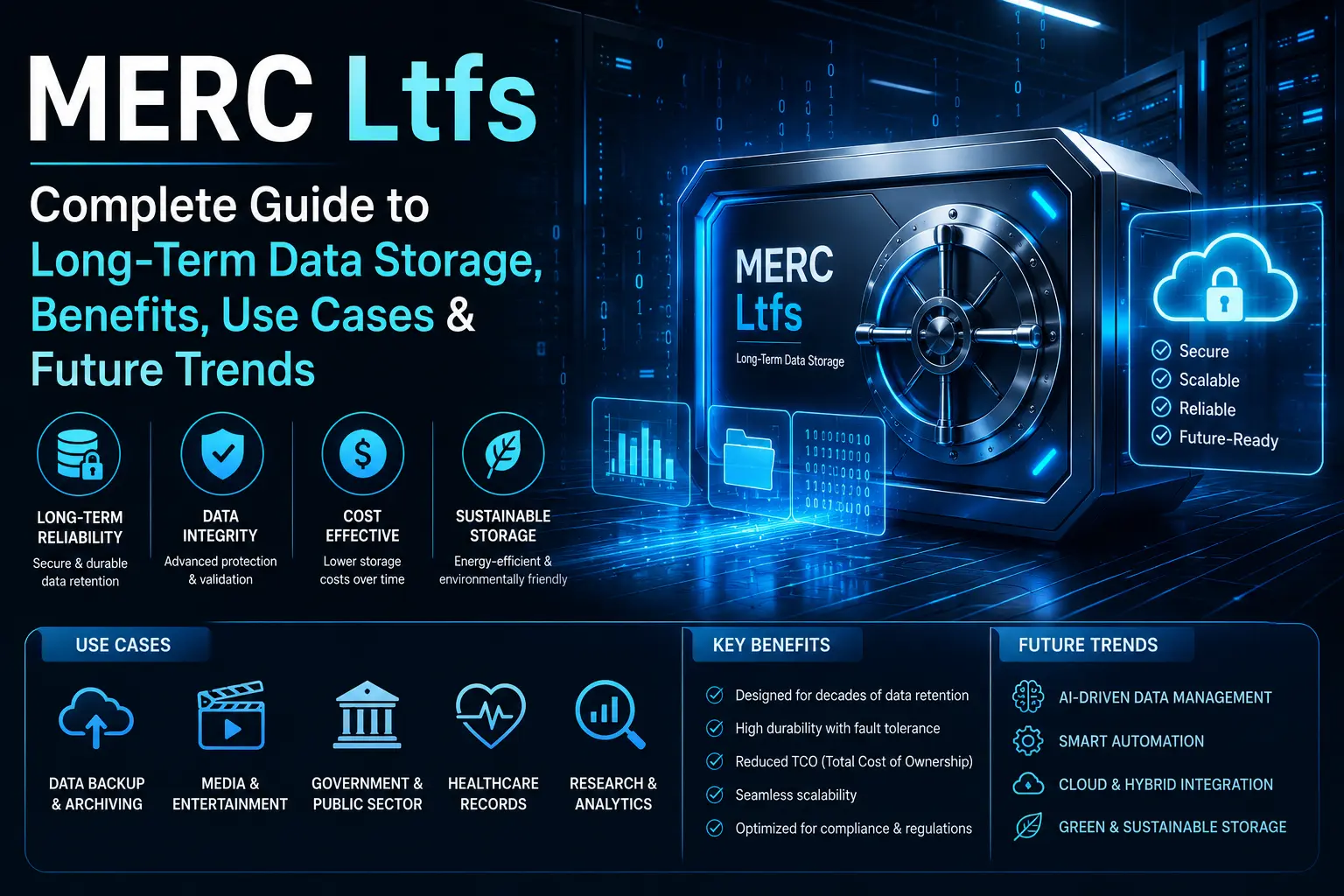
In today’s digital economy, organizations generate unprecedented amounts of data every day. From customer records and financial transactions to scientific research and media archives, the need for reliable long-term storage has become more important than ever.
According to industry estimates, global data creation is expected to exceed 180 zettabytes annually by the end of the decade. As businesses face growing storage demands, traditional hard drives and cloud systems are not always the most cost-effective solution for long-term retention.
This challenge has led many organizations to explore MERC Ltfs, a storage approach built around Linear Tape File System (LTFS) technology. LTFS enables magnetic tape storage to function similarly to a conventional file system, allowing users to access archived files more easily while benefiting from the low cost and durability of tape-based storage.
This guide explores how MERC Ltfs works, its advantages, industry applications, and why it continues to play a critical role in enterprise data management.
Understanding the Growing Data Storage Challenge
The world is experiencing an unprecedented data explosion.
Organizations generate information from:
- Business applications
- Customer interactions
- IoT devices
- Artificial intelligence systems
- Video content
- Research projects
- Regulatory reporting
As data volumes grow, businesses must balance three key objectives:
- Cost efficiency
- Data accessibility
- Long-term reliability
While cloud storage offers flexibility, storing petabytes of infrequently accessed data can become expensive over time. This is where tape-based archival solutions remain highly relevant.
Industry experts continue to recognize tape storage as one of the most economical methods for long-term retention, particularly for cold data that requires preservation rather than constant access.
What Is MERC Ltfs?
MERC Ltfs refers to a storage framework that utilizes Linear Tape File System technology to simplify access to tape-based archives.
Traditionally, tape storage required specialized software and complex retrieval processes. LTFS changed this by introducing a self-describing file system format that allows users to browse tape contents similarly to external drives or removable storage devices.
The technology was originally developed within the LTO ecosystem and later became an industry-standard format supporting long-term archival requirements.
Key objectives include:
- Simplified archive management
- Improved data accessibility
- Lower storage costs
- Long-term preservation
- Cross-platform compatibility
These capabilities make LTFS particularly valuable for organizations managing large volumes of historical or compliance-related information.
How LTFS Technology Works
One of the most innovative aspects of LTFS is its ability to make tape storage behave like a traditional file system.
The architecture generally consists of two primary sections:
Metadata Partition
This section stores:
- File indexes
- Directory structures
- Metadata information
The index allows systems to quickly identify file locations without scanning the entire tape.
Data Partition
This section contains the actual archived files.
When users request information, the system references the index and retrieves the relevant data from the storage partition.
This design dramatically improves usability compared with older tape-management approaches.
Why Organizations Continue to Invest in Tape Storage
Many people assume tape storage has become obsolete.
The reality is quite different.
Major enterprises, cloud providers, media companies, research institutions, and government agencies continue to use tape for long-term archival purposes because of its unique advantages.
Lower Cost Per Terabyte
Tape storage remains significantly more economical than maintaining massive disk arrays for rarely accessed data.
Organizations archiving petabytes of information can achieve substantial cost savings over time.
Exceptional Longevity
Properly maintained tape media can preserve information for decades.
Many storage experts cite tape as one of the most durable archival mediums available today.
Reduced Energy Consumption
Unlike spinning disk systems, tape cartridges consume virtually no power while sitting in storage.
This contributes to:
- Lower operating costs
- Reduced cooling requirements
- Improved sustainability
Strong Cybersecurity Benefits
Offline tape storage creates a natural air gap.
Because tapes are not continuously connected to networks, they offer protection against:
- Ransomware
- Malware attacks
- Unauthorized access
- Data corruption
These advantages have become increasingly important as cyber threats continue to rise.
Core Benefits of MERC Ltfs
Organizations adopting MERC Ltfs often experience benefits across multiple operational areas.
Simplified Data Access
LTFS eliminates much of the complexity traditionally associated with tape storage.
Users can:
- Browse files
- Search directories
- Transfer information
- Manage archives
using familiar file-system interfaces.
Vendor Independence
LTFS is built upon open standards.
This helps reduce dependency on proprietary systems and improves long-term accessibility.
Scalability
Organizations can expand storage capacity without dramatically increasing operational expenses.
Tape systems are capable of supporting extremely large archive environments.
Compliance Support
Many industries face strict regulations regarding data retention.
Examples include:
- Financial services
- Healthcare
- Government agencies
- Legal organizations
Long-term archival solutions help organizations meet regulatory obligations while maintaining data integrity.
Real-World Industry Applications
The practical value of LTFS extends across numerous sectors.
Media and Entertainment
Video production companies generate enormous volumes of high-resolution content.
4K and 8K workflows create storage requirements measured in petabytes.
Tape archives help preserve:
- Raw footage
- Completed productions
- Historical content
- Broadcast assets
Many broadcasters adopted LTFS specifically because of its efficient handling of large media files.
Healthcare
Healthcare providers must retain patient information for extended periods.
Examples include:
- Medical imaging
- Diagnostic records
- Research datasets
- Compliance documentation
Cost-effective archival systems support these requirements while maintaining security.
Scientific Research
Research institutions generate enormous datasets through:
- Genomics
- Climate studies
- Astronomy
- Physics research
Many projects require long-term preservation and future accessibility.
Financial Services
Banks and financial institutions must retain transaction records for regulatory purposes.
Long-term storage systems help support:
- Audit readiness
- Risk management
- Compliance requirements
- Historical analysis
MERC Ltfs and Cloud Storage: Complementary Technologies
Some organizations mistakenly view tape and cloud storage as competing technologies.
In reality, they often work together.
A common strategy involves:
Cloud for Active Data
Frequently accessed information remains available through cloud platforms.
Tape for Archive Data
Historical records move into low-cost tape environments.
This hybrid approach delivers:
- Cost optimization
- Improved scalability
- Enhanced resilience
- Better lifecycle management
Modern enterprise architectures increasingly combine both technologies.
Security Advantages in the Age of Cyber Threats
Cybersecurity has become a board-level concern for organizations worldwide.
Ransomware attacks continue to target businesses of every size.
Offline archival storage provides several important protections:
Air-Gapped Protection
Disconnected media cannot be encrypted by ransomware while offline.
Immutable Archives
Organizations can preserve historical records in their original form.
Disaster Recovery Support
Archived copies help organizations recover from:
- Hardware failures
- Data corruption
- Cyber incidents
- Human error
Security experts increasingly recommend maintaining offline backup copies as part of comprehensive resilience strategies.
Emerging Trends Shaping the Future
The future of long-term storage continues evolving.
Several trends are expected to influence adoption over the coming years.
Artificial Intelligence
AI workloads generate enormous volumes of training and operational data.
Organizations need scalable archival solutions for long-term retention.
Regulatory Expansion
Governments continue introducing new compliance requirements related to:
- Privacy
- Data governance
- Financial reporting
- Healthcare information
Long-term storage solutions will remain essential.
Sustainability Initiatives
Energy-efficient storage technologies are gaining attention as organizations pursue environmental goals.
Tape storage’s low energy consumption supports these objectives.
Hybrid Infrastructure
Future storage environments will increasingly combine:
- Cloud platforms
- Object storage
- Disk arrays
- Tape archives
Integrated management systems will improve visibility across all storage tiers.
Best Practices for Successful Implementation
Organizations considering LTFS-based storage should follow several best practices.
Develop a Retention Policy
Clearly define:
- What data should be archived
- Retention periods
- Compliance requirements
Classify Data Properly
Not all information belongs in long-term archives.
Identify cold data suitable for tape storage.
Test Recovery Procedures
Regular restoration testing ensures data remains accessible when needed.
Maintain Metadata Accuracy
Proper indexing improves retrieval speed and operational efficiency.
Integrate Security Controls
Apply encryption, access controls, and audit procedures to protect archived information.
Read More: Miuzo: The Emerging Digital Platform Shaping Modern Collaboration
Conclusion
As data volumes continue growing worldwide, organizations need storage strategies that balance cost, security, accessibility, and scalability.
MERC Ltfs represents a practical solution for long-term archival management by combining the affordability of tape storage with the usability of modern file systems. Through standardized indexing, simplified file access, and strong durability, LTFS has transformed how enterprises preserve critical information for future use.
From healthcare and finance to scientific research and media production, organizations continue relying on LTFS-based architectures to manage growing archives efficiently. As regulatory requirements expand, cybersecurity threats increase, and sustainability becomes a strategic priority, the role of tape storage in enterprise infrastructure is likely to remain highly relevant.
For businesses seeking reliable long-term retention without excessive operational costs, MERC Ltfs remains one of the most effective archival approaches available today.
